Saturday, February 27, 2010

Theen Tamasha : Theen Taal- An overview

Here is an excerpt from the catalogue text for Theen Tamasha : Theen Taal by Lina Vincent Sunish.

THE ENSEMBLE


The jugalbandi in Indian classical music is a duet performance by two musicians of equal standing, vocalist or instrumentalist, both contributing equally to the dimensions of the performance. Poetic license will allow me to extend the concept in talking about the character of   ‘Theen Tamasha: Theen Taal’ and the three artists who make it what it is. Here, the concept offers a framework with which to understand the layers of engagement the artists share with each other and with their audience, allowing each of them to present an individual voice while being part of a collaborative ethos. The collective they have formed provides a mooring for serious discourse, and also creates the space for improvisation and learning, building a synergy that generates meaningful and enjoyable exchange. In bringing the work of Malavika Rajnarayan, Kim Kyoungae and Sonatina Mendes together, my role has been that of a participant in that synergy.  


The traditional pictorial surface of the canvas or paper has not lost its primacy even in the face of the more pluralistic arts that depend on multimedia, mainly because of the medium’s immense capacities to communicate, tell stories and engage. Here we have three characteristic styles of painting growing out of, and related to different cultural and academic backgrounds. Chance elements and imagery in each ones style that seem familiar, or recognizable, might have their origin in sources and experiences far removed from what our assumptions might be, that is the quality of contemporary art today. So, my intention is to foreground the essentially experiential quality of each of their work rather than build onto their visual languages a structure of connections based on established art historical categories or lineages. This show is meant to describe more fully the palpable resonance their work shares, as yet seen only on the virtual space of their shared blog.


The fact that they are women, and there is a distinct realization of femininity in their respective work is a relevant aspect of the show, but not overriding their voices as creative artists invested in producing a significant contemporary identity through their painting. The exhibition showcases what can be called ‘lifescapes’, each artists work reflecting to a different degree experiences of life’s banalities and mysteries, with memory and history to bind it together. 

Saturday, February 20, 2010

Showing in Bangalore: Theen Tamasha:Theen Taal

Theen Tamasha is proud to announce its exhibition at Gallery Time and Space in Bangalore.

The preview of Theen Tamasha:Theen Taal opened on the 25th of February, 2010. For all those who cannot visit the gallery, we're uploading all the works that will be exhibited.

Happy Viewing!
Paintings by Sonatina Mendes


"Hearts of Glass" Oil on canvas 2009 36" X 48"


"Group" Oil on canvas 2010 10" X 6.5"


"Actors" Oil on canvas 2010 10" X 7.5"


Untitled Oil on canvas 2010 23" X 23"

Untitled Oil on canvas 2009 23" X 23"


Untitled Oil on canvas 2010 23" X 23"


"The Memory House" Oil on canvas 2009 48" X 39"


"Openings in the mountain" Oil on canvas 2009 60" X 42"


Paintings by Kim Kyoungae


Paintings by Malavika Rajnarayan

'And after all, we're extraordinary women' Acrylic on canvas 2009 48" X36"


Untitled Acrylic on canvas 2010 36" X 36"


"All that was heard" Acrylic on canvas 2009 60" X 48"


"Conversation" Acrylic on canvas 2009 60" X 48"


"Rebel" Acrylic on canvas 2010 36" X 36"


"Dreams from Afar" Acrylic on canvas 2009 48" X 30"


"Excavating histories" Acrylic on canvas 2009 60" X 48"


Wednesday, January 20, 2010

Showing now!

Kim Kyoungae's Solo Exhibition 'Resonance' opens at Hacienda Gallery, Kalaghoda, Mumbai on the 21st of January 2010 at 6:30 p.m. You can view the paintings here and read the text that accompanies the exhibition.


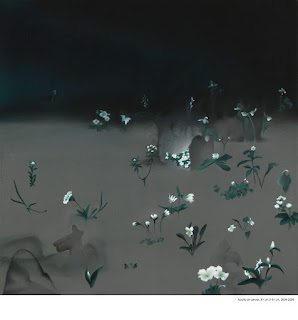


In the silence of resonating memories,

Small fragments piece together new images.


Many people were dressed up as if it were mid-summer. Feeling awkward, I looked up and down at myself. Is it not spring? Is something wrong with my memory? I blamed global warming for altering my truth.


The scenery outside the airport looked familiar to me, but the air seemed fresher than what I had expected. I was home and it was a feeling instantly reassuring and comforting. Lost in her thoughts, my daughter was rather silent. She allowed me to be in my own world as she sat quietly by my side in the bus that took us to my hometown from the airport. The landscape outside appeared unfamiliar to Aditi. Looking through the window I saw an endless chain of mountains: hills every where - east or west, north or south; like a screen unfolding for me. I knew in that moment how much I had been missing them. I suddenly remembered my days of trekking. Now, only as memory, it came back like a magical dream, those days spent in these reclusive mountains; exploring the wilderness and letting time stand still within my consciousness.


After four hours on the highway we finally reached home. I spotted my mother among the people waiting for us at the bus stop. She looked much the same; calm and collected and infused with an energy and wisdom I always associate with her. My nephew, the little boy, had grown up. It was a moment of joy to see them all again, and the five years of separation melted away quickly.


The road near our house had become wider and many new buildings had sprung up in the neighbourhood. An apartment building stood in the old paddy field. Changes all around, yet it looked so familiar. My home remained almost the same, with the front gate still waiting to be installed. This unattended opening somehow proclaims an entry for everyone, and my father appears to have no desire to ever build this gate. It reminds me of Kim Kiduck film ‘Spring, Summer, Autumn, Winter and Spring’. This film has a Buddhist temple in the centre of a lake with a wooden gate without walls, and the monks and visitors entered only through the gate.


The then and the now will always dictate my assimilation with my homeland. The idealised memory, and who I become with time away from its borders, all resonate to formulate new perceptions to the way I re-enter my past. My home: I still call it my home : now looked old and shrunken with the roof so low as if it had suddenly dropped down; and yet it was these very rooms that were the entire world that held our lives so effortlessly. Where my sister and me haggled endlessly, sharing and squabbling and growing in the very room that now looked cramped and tiny and constricting to me.


I slipped back into a rhythm of my surroundings and did nothing for all of the next week. It was nice to spend time reading books or just watching television. Evenings were spent retracing the old roads and pathways. Where has “grandma” - the fine pine tree gone? She was right here like a guardian as far as one could remember. She has disappeared; where is she? Slowly, I recalled the location where she stood. Her truncated roots now lie under thick asphalt. Memories often overwhelm you. But changes have their own charm. It frees one from shackles. It also shatters many dreams.


Friends brought back memories. They too had changed. Kokji came over for a cup of tea. She had been ill for sometime and looked weak due to chemotherapy. There is another old friend of mine. We used to fight every day. He came by and filled me with news about all our old friends and classmates. He warned me about the onset of recession. I didn’t understand much about it at that time. I admire his wisdom now.


Programmes on television were all so different, making the change around me more apparent. My TV teenage idol is no more the same and I felt oddly betrayed. Whether because his idealised image no longer holds true today or whether I was confronting my own dislocate with what had once inspired me; I really do not know. I watched a moving documentary on sex slaves of the Second World War. Many teenage girls and women were forced to become sex workers to serve the Japanese army during the war. It was a tragic and heart wrenching incident that could not be resolved even after so many years.


I have been examining this issue for many years out of my own need to comprehend a psychology that collectively allows for such situations to ever exist. Today the silence of shame and humiliation is thankfully over and people are much more aware of this horror of history. The aged victims have been demanding a public apology from the Japanese government and are refusing to accept material compensation which has no meaning in this stage of their lives. With a little more than two hundred victims still alive in the official records they soon will be forgotten forever, as old age takes them away from this earth. I can’t describe to you the feelings I had when I saw the photograph of the temporary construction where this inhumanity took place. I just closed my eyes and felt consumed by the deepest sorrow. Many women could not go back to their families even after the war ended. They have been living away from their homeland since then. A number of them, severely suffering from guilt became mentally unstable. Nothing can ever make amends for their loss and I mourn their trampled lives with all my heart.


Five weeks passed so quickly. I sat on the flight back to India full of mixed feelings. In contrast, Aditi looked quite content.


Kim Kyoungae

Baroda 2010


Art Camp in Kutch


I spent the second week of January in Hodka, a small village in Kutch, where I camped with 20 other artists, exploring the region, interacting and painting. Art camps are enriching experiences where artists work in a collective environment, allowing ideas to grow through dialogues, conversations, and by feeding off energies from one another.  

I had visited Kutch in 2004 November, motor-biking through the desert and halting at villages to see the continuation of craft traditions. The invitation to this camp was in many ways like a call from an old friend; and I set out on the trip anticipating and expecting experiences that I'd known to be distinctive of Kutch. To my pleasant surprise, it was like meeting a new friend. The landscape swept me away when we crossed the border into "No-man's land"-  a territory that belongs to neither India nor Pakistan -the whiteness of the salt desert shimmering in the noon sun. The horizon line that extends towards the border poetically fades away at sunset on the Great Rann of Kutch, the sky and earth unite in misty hues of white, grey, peach and lilac. 

My studio looked out into a silent sprawling shrubby desert landscape where I'd see horse-riders every morning, almost like they'd just jumped off a persian painting! The sparseness of the desert compliments the richness of the art and crafts in Kutch. 

Every evening was spent in viewing artworks and sharing artistic experiences, watching short films and dining together with beautiful folk music / dance being performed for us. One of the films that I thoroughly enjoyed was an animation film called Sita Sings the Blues and you can all watch it here.

Serene as it may sound, our art camp was energized with every artist painting furiously  through the day and night in tents and huts that became our studios to realize small ideas that were ignited by coming together in a wondrous place.

Malavika Rajnarayan


Monday, December 14, 2009

Open Window: Kwon Kiyoon


When I received Kwon Kiyoon's catalogue of his solo show a few days back, I remembered my last meeting with him in May 2008 in Korea. I’d met him as I’ve done so on every visit to Korea. He was one of my teachers while I was studying in college and have been inspired after every interaction with him.

 Kwon Kiyoon graduated from Seoul National University in the early eighties and  chose to return to his hometown, Andong, which was a centre for scholars. In 1988, he began to paint the landscape of Andong and its surroundings. His interest in the 17th century painter Jung Sun led him to study the classical tradition of landscape painting. Jung Sun had changed the way landscape painting was practised in the history of Korean painting when he began to paint outdoors. Landscape painting had until then been primarily constructed from the painter’s imagination of the observed world. The art forms of painting, literature, calligraphy and seal-making were interwoven and inseparable until the 20th century and Kwon Kiyoon’s art practice can be viewed from this premise.

Kwon Kiyoon uses a methodology where he chooses an outdoor location and works on a painting from start to finish in order capture the spirit of the landscape at that particular site. However, his landscapes reflect the philosophies of classical Korean and Chinese landscape painters, where the painting surpasses the depiction of what is seen and is invested with the artist’s experience of life. 


"Sukmoon" 96 cms X 39 cms Chinese ink and watercolour on handmade paper 2008

"Moorung's spring" 58 cms X 97 cms Chinese ink and watercolour on handmade paper 2009

"Samgujung's pine tree" 97 cms X 50 cms Chinese ink and watercolour on handmade paper 2009

"Guryong waterfall" 64.5 cms X 34.5 cms Chinese ink  on handmade paper 2006

"Suok waterfall-1" 57.3 cms X 40.5 cms Chinese ink and watercolour on handmade paper 2004

"Chungyung Buddhist temple"  Chinese ink on hand fan 2007

"Chungyung Mountain-3" 31.5 cms X 26.5 cms Chinese ink  on handmade paper 1995

Kim Kyoungae

Thursday, October 22, 2009

Travel: Udaipur

Traversing through centuries on the same terrain...snapshots, references and drawings from a two-day trip to Udaipur; the mighty kingdom of Mewar.


Malavika Rajnarayan